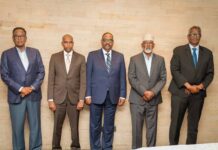
MOGADISHU (Somaliguardian) – Somalia’s opposition leaders declared on Sunday their intention to organize a parallel election if President Hassan Sheikh Mohamud proceeds unilaterally with his preferred electoral model, following a high-stakes meeting held at the residence of former President Sharif Sheikh Ahmed in Mogadishu.
The gathering, which took place in a tent erected on the rooftop of Ahmed’s home, was allegedly necessitated by a government ban on opposition meetings in hotels across the capital, leaving the coalition with limited options to convene.
In a sharply worded statement, the opposition accused President Mohamud of plundering national resources, imposing oppressive and unjustified taxes on Mogadishu’s businesses, unilaterally drafting a new constitution, and failing to support Puntland’s efforts to combat ISIS.
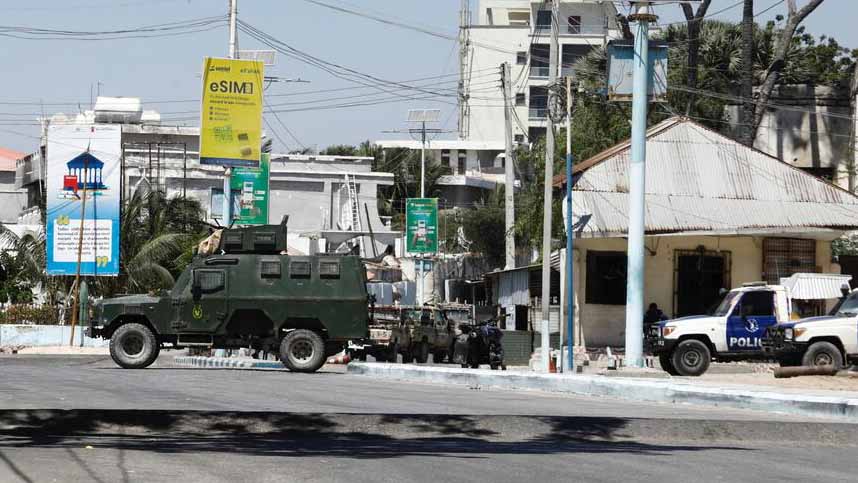
The leaders further alleged that the President is mobilizing over 10,000 troops to suppress dissent as the election period approaches, raising fears of a return to authoritarianism and political violence.
The meeting, attended by prominent political figures, underscored growing concerns over the country’s fragile political stability. Speakers warned that the incumbent administration’s actions risk plunging Somalia back into the chaos of the warlord era and potentially reigniting civil war. They argued that the President’s policies are steering the nation toward an abyss from which recovery may be impossible without immediate corrective action.
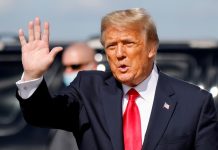
President Mohamud, however, remains steadfast in his commitment to a one-person, one-vote electoral system, dismissing opposition demands as inconsequential. “Those who oppose this process will be ignored,” he declared, emphasizing his administration’s determination to move forward with the plan.
The proposed direct voting model has been met with widespread skepticism and outright rejection by key stakeholders, including the regional states of Puntland and Jubaland, as well as opposition leaders.
Critics argue that the government’s limited control over vast swathes of the country, coupled with persistent security challenges, renders the logistical feasibility of such an election untenable. They contend that organizing a credible nationwide vote under current conditions is unrealistic.
Instead, the opposition is advocating for a return to Somalia’s traditional indirect electoral model, wherein a select group of elders pick members of parliament, who then elect the president. This system was last employed in 2022, when MPs convened in a makeshift tent at Mogadishu’s Aden Adde International Airport to choose the nation’s leader.
President Mohamud and his Prime Minister, however, have dismissed calls for reverting to the old system, framing it as a step backward.
The political impasse has heightened tensions in a nation already grappling with insurgency, economic instability, and the lingering effects of decades-long conflict. As the standoff intensifies, fears are mounting that the deepening rift between the government and opposed political stakeholders could destabilize the country further, jeopardizing hard-won gains in Somalia’s fragile state-building process.
Contact us: info@somaliguardian.com