MOGADISHU (Somaliguardian) – A breakaway faction from Somalia’s main opposition alliance has signed an electoral agreement with President Hassan Sheikh Mohamud, dealing a significant blow to the broader opposition movement.
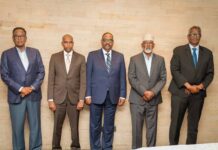
The group – comprising former Prime Minister Omar Abdirashid Ali Sharmarke, ex-parliamentary speakers Mohamed Mursal and Sharif Hassan Sheikh Adan, and veteran diplomat Dahir Mohamud Gelle – split from the powerful Salvation Forum over the weekend.
In a joint communique issued on Monday, both sides endorsed a revised electoral framework that would shift the country closer to a one-person, one-vote system. Under the agreement, federal lawmakers will be elected by popular vote and will, in turn, elect the president – a partial departure from Somalia’s traditional indirect electoral model, in which clan elders select MPs who then vote for the head of state.
The agreement also reaffirms a parliamentary system in which the president appoints the prime minister, subject to parliamentary approval and dismissal through a vote of no confidence. This clause directly contradicts constitutional amendments pushed by President Mohamud’s administration, which proposed a shift to a presidential system featuring a vice president but no prime minister.
Crucially, the upcoming elections will be conducted under a 2024 electoral law designed to align with the terms of the agreement. Regional leaders, meanwhile, will be chosen by their respective state parliaments, and any political organization securing at least 10% of federal parliamentary seats will be formally recognised as a national party.
The agreement is widely seen as a political coup for President Mohamud, who has successfully fractured the previously united opposition and secured influential allies ahead of the next electoral cycle.
However, the development marks a setback for key opposition figures, including former President Sharif Sheikh Ahmed, who continue to insist that full universal suffrage is neither feasible nor secure in the current climate. They cite the government’s limited territorial control, persistent insecurity, and logistical challenges as key barriers.
While the agreement pledges cooperation on national unity, counterterrorism, and the conduct of peaceful elections, questions remain over its implementation. It is still unclear whether other key stakeholders – including the federal member states of Puntland and Jubaland, as well as the rest of the opposition – will be included in the process.
Without their participation, any eventual outcome risks lacking the national consensus and legitimacy critical to Somalia’s fragile political transition.
Contact us: info@somaliguardian.com